No matter what repair or improvement you are doing around your home you can and should try to use sustainable materials wherever you can.
Plastic and metals are poor for the environment because at every stage of their life cycle. The extraction of raw materials, manufacturing and transportation are all energy-intensive, land hungry and highly polluting. Sometimes you have to use these materials – plumbing and electrics for example – just make sure you use every last bit of the material. Don’t waste any. If you don’t use it all pass it on to someone who will.
Is Wood Sustainable
Yes it is. In fact, it is one of the few truly sustainable building materials and the only one that has the strength to be used for serious structural applications. However, there are of course some caveats.
The video below explains the environmental advantages of wood quite nicely so have a watch or read on for more details.
FSC Certified Wood
This quality label is about more than the environment. It signifies that the timber is from responsibly managed, socially beneficial, environmentally conscious and economically viable sources. Wow!
Our main interest is in the environmental credibility this label bestows. Wood is of course chopped down before it can be used by us. However sourcing timber from sustainably managed forests ensures the wood removed from the forest is replaced with new seedling which will grow and become the timber for future years. Virgin forest containing ancient hardwoods is not harvested or destroyed. Instead, existing areas of managed softwood forests are planted, managed, harvested and replanted.
Carbon Neutral?
We all know that we need to drastically reduce the carbon we release into the atmosphere and also try to remove some the carbon already released. Using timber rather than concrete or aluminium does both these things.
As trees grow they suck up CO2 from the air and incorporate it into their structure. So the timber you see used in your home and garden is actually a store of carbon. Young trees grow rapidly and use more carbon than older trees, so constantly regenerating FSC woodlands are one giant carbon store. This is one of the main reasons wood is so environmentally sound.
When you compare the carbon footprint generated over the whole life cycle of building materials – extraction, processing, transportation and disposal – wood comes out the best by far. The graph below shows the Greenhouse Gas Emissions (kg C02 eq per m3 of material) of various building materials.
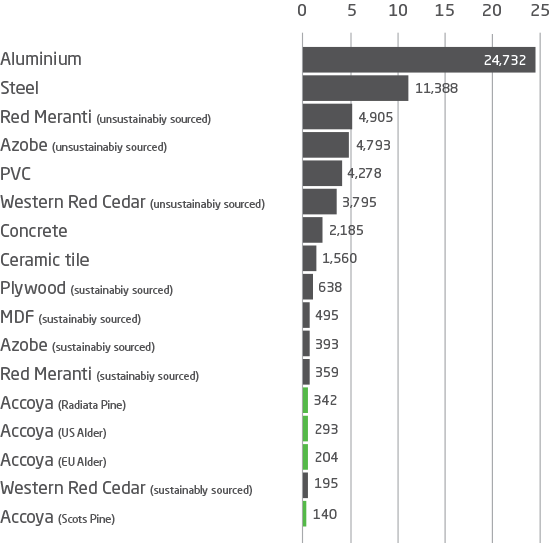
Wood has a drastically smaller carbon footprint than the alternatives. In some applications, wood use can be carbon neutral and even carbon negative.
Treated Wood
Softwood forests are very sustainable but one of the reasons people prefer to use hardwoods is that they last longer, are more resistant to rot and are stronger. Luckily we now have some excellent ways to treat softwoods to give them some or all of these superior strength and durability characteristics.
Many of these treatments involve heat pressure and toxic chemicals which increase their carbon footprint and create nasty pollution. Few of us want to use chemically treated wood in our homes and gardens. There are a few wood technology processes however that are still low carbon and do not involve toxic chemicals. Find a wood that has some heavy-duty environmental certifications; like C2C, Leed, FSC, Breeam to give you the confidence the source is sustainable and non-polluting.
Thank you to Accoya for letting us use their image and video resources for this article.